The 6-3 Supreme Court decision upholding Tennessee’s ban on puberty blockers and hormone therapy for transgender teenagers has officially rewritten the landscape of healthcare and bodily autonomy in our state. Writing for the majority, Chief Justice John Roberts effectively washed the Court’s hands of the issue, concluding that the Constitution’s guarantee of equal protection does not shield gender-affirming care. He wrote that the Court must leave questions regarding this policy to “the people, their elected represent.
Tennessee legislature to restrict the rights and medical privacy of transgender inmates
Tennessee has implemented several measures restricting transgender rights, including a ban on gender-affirming care for minors and the redefinition of sex as an immutable trait determined at birth. New legislation also requires reporting transition-related data and allows public employees to decline using preferred honorifics in professional settings.
State-Sanctioned Erasure
Intatives, and the democratic process.” While the headlines rightly focus on the devastating impact this has on transgender youth and their families, there is a quieter, equally urgent crisis unfolding in the shadows of this rhetoric. The same political machinery driving the SB1 youth healthcare ban is actively working to dismantle the survival mechanisms of transgender adults trapped within the carceral system.
The 2026 Legislative Reality for Incarcerated Transgender People
The SCOTUS decision did not occur in a vacuum. It is part of a sweeping legislative strategy to erase transgender identities from state institutions. In the spring of 2026, the Tennessee legislature passed the “Riley Gaines Women’s Safety and Protection Act”.
This 2026 law legally redefines sex based strictly on “visible genital anatomy” observed at birth, intentionally dismissing gender identity entirely. Crucially, this legislation dictates how individuals are housed in state accommodations, expressly targeting correctional and juvenile detention facilities. Under this law, prisons in Tennessee are forced to restrict incarcerated transgender women to men’s housing, without exception for their health or safety.
This mandate directly undermines federal protections like the Prison Rape Elimination Act (PREA), which was designed to protect incarcerated people from sexual violence. Transgender individuals are already uniquely vulnerable; advocacy data shows they are nine times more likely to experience sexual assault or harassment while detained, with transgender women of color facing the highest risks. Mandating that trans women be housed in male facilities maliciously endorses an epidemic of trauma, sexual violence, and the overuse of solitary confinement under the guise of “protection”.
The policies shaping our prison systems are fueled by the rhetoric of our elected officials. U.S. Senator Marsha Blackburn has been a leading architect of this narrative.
Marsha Blackburn’s Weaponization of Rhetoric
In late July 2026, Senator Blackburn co-sponsored the “Protecting Our Kids from Harmful Research Act,” a piece of legislation introduced by Senator Mike Lee (R-UT) aimed at banning the use of federal funds for medical research or studies promoting gender transitions for minors.
In a public statement released on July 30, 2026, backing the legislation, Blackburn stated:
“Taxpayers should not be spending a penny on research done by those who want to push harmful gender transition surgeries and radical gender ideology on our kids. The Protecting Our Kids from Harmful Research Act would prohibit the use of federal funds for any research or study on gender transition surgeries for minors.”
Her statements align with her broader, ongoing legislative focus on framing gender-affirming care as an “ideology-driven” danger to children, a position she also pressed as a vocal critic during Senate hearings on gender transition care for minors earlier in May 2026.
While Senator Blackburn may not regularly speak on the specific administrative policies of the Federal Bureau of Prisons or Tennessee’s state detention infrastructure, her established legislative record opposes the foundational concepts of gender-affirming housing and healthcare. Her active efforts to bar transgender women from female-designated spaces—coupled with her characterization of gender-affirming medical care as an ideology-driven danger—firmly position her against policies that would allow transgender inmates to be housed according to their gender identity or to access transition-related medical care while incarcerated.
“No child should be pushed into irreversible chemical and surgical mutilation under the guise of so-called ‘gender-affirming care’.”
While Blackburn frequently uses youth to anchor her talking points, classifying medically recognized, life-saving healthcare as “mutilation” has profound and immediate consequences for incarcerated adults. When the state’s highest officials delegitimize gender-affirming care, they give the Department of Correction a politically sanctioned excuse to deny hormone therapy and medical support to transgender inmates.
If the state views gender-affirming care as a harm rather than a medical necessity, the 8th Amendment right protecting inmates from “cruel and unusual punishment”—which courts have previously interpreted to include the denial of gender dysphoria treatment—is structurally undermined. The trauma inflicted by abrupt hormone withdrawal, combined with the daily terror of being housed in facilities that do not align with one’s gender identity, creates an environment of systematic, institutional cruelty.
Institutional Reform and the Path Forward
Justice Sonia Sotomayor warned in her dissent on the SB1 ruling that the Court “authorizes, without second thought, untold harm.” Today, that harm is echoing against the concrete walls of Tennessee’s detention centers.
True institutional reform requires looking at the most vulnerable populations among us. We cannot talk about LGBTQ+ rights without centering the lived experiences of LGBTQ+ people in prison. The fight for bodily autonomy does not end at the clinic door; it extends into the cell block.
When the courts leave the humanity of marginalized people up to the “democratic process,” public education and truth-telling become our most vital tools. We have to continue documenting these realities, challenging the policies that codify abuse, and building resilient networks of support. The survival of transgender inmates depends on our refusal to let their stories be erased from the public record.
The Tennessee Attorney General’s acquisition of private medical records from Vanderbilt University Medical Center has sparked intense fear and privacy concerns among patients. Collectively, these actions have created a fraught environment prompting some families to flee the state while others remain to protest what they describe as a systemic erasure of their identity.
The Precedent: United States v. Skrmetti and SB1
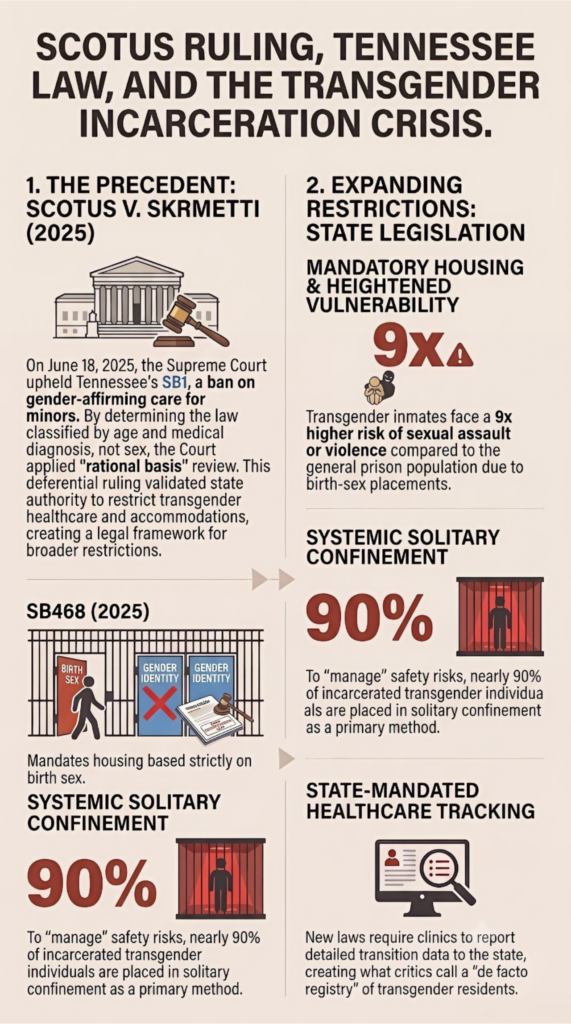
The foundation for Tennessee’s recent legislative expansion was laid on June 18, 2025, when the U.S. Supreme Court upheld Tennessee’s SB1 in United States v. Skrmetti. By determining that the state’s ban on gender-affirming care for minors classified individuals based on age and medical diagnosis rather than sex, the Court applied a deferential “rational basis” review instead of heightened scrutiny. This ruling validated the state’s authority to restrict transgender healthcare and accommodations, creating a legal framework that Tennessee legislators have since used to expand restrictions into adult and incarcerated populations.
Bars transgender individuals from domestic violence shelters, correctional facilities, and juvenile centers that align with their gender identity, mandating accommodations based on sex assigned at birth.
Requires all local and state governmental entities to revise policies to define sex as an immutable characteristic determined by anatomy and genetics at birth, overriding local identity-based protections.
The Crisis for Incarcerated Transgender Inmates in Tennessee
The convergence of these laws has created a uniquely dangerous environment for transgender inmates in Tennessee.
The enforcement of these policies has resulted in a multi-faceted institutional crisis
Mandatory Housing by Birth Sex: SB468 explicitly restricts transgender individuals from being housed according to their gender identity in state facilities. The infographic emphasizes that this forces placements based strictly on birth sex.
Heightened Vulnerability: The infographic notes that transgender inmates face a 9x higher risk of sexual assault or violence compared to the general prison population.
Systemic Solitary Confinement: The visual data from 2167.png indicates that nearly 90% of incarcerated transgender individuals are placed in solitary confinement as a primary method to manage the safety risks created by these housing mandates.
State-Mandated Healthcare Tracking: Compounding the housing and safety crisis, the infographic highlights that new state tracking laws require medical clinics to report detailed transition data to the state, creating what critics call a “de facto registry.”
Marsha Blackburn has consistently refused to participate in any debates against her Republican primary challengers in 2026
The scandal has been compounded by Blackburn’s broader refusal to engage with the press or host open town halls
Declined Interviews: Major local publications, including the Nashville Scene, have reported that Blackburn has repeatedly declined their requests for interviews during this election cycle.
Avoiding Public Forums: She has faced explicit criticism for avoiding public forums where everyday voters could freely ask her questions prior to the start of early voting.
Leaked Campaign Documents: In mid-July 2026, a leaked document revealed that her campaign stops are “carefully scripted,” renewing press and voter concerns about how genuinely she interacts with constituents and how accessible she would be if elected to the governor’s office.
Impact of Tennessee Anti-LGBTQ+ Bills on Transgender Inmates
In 2026, transgender inmates in Tennessee face the loss of gender-affirming healthcare and mandatory placement in facilities based on sex assigned at birth due to the newly passed “Riley Gaines Women’s Safety and Protection Act.” These legislative shifts, alongside a 2026 federal policy ban on care, have increased hostility from staff and created fears of physical and sexual assault within the prison system. Increased hostility from staff and concerns over healthcare and pronoun usage contribute to inmate fears. With Marsha Blackburn expected to the governor’s race, we can only assume things will get worse when she takes office in Tennessee next year.
About Michael Eric Williams
Michael Eric Williams is a Nashville‑based advocate focused on law enforcement communications, institutional reform, and LGBTQ+ inmate protections. He works on policy development, accountability frameworks, and evidence‑based reform strategies that strengthen transparency, safety, and oversight across correctional systems in Tennessee. In his free time, Michael enjoys mountain biking and spending time with his husband Todd and their elderly chihuahua Ms Alice.
The Tennessee Supreme Court has recognized the growing access-to-justice crisis and is now asking the public for ideas on how to respond. The Court needs to hear from you! Submit a letter to the Court by March 16 2026.
Sheriff Daron Hall has implemented progressive reforms, including the Behavioral Care Center and improved jail facilities, aiming to treat individuals with dignity and reduce recidivism, highlighting the need for statewide systemic change.