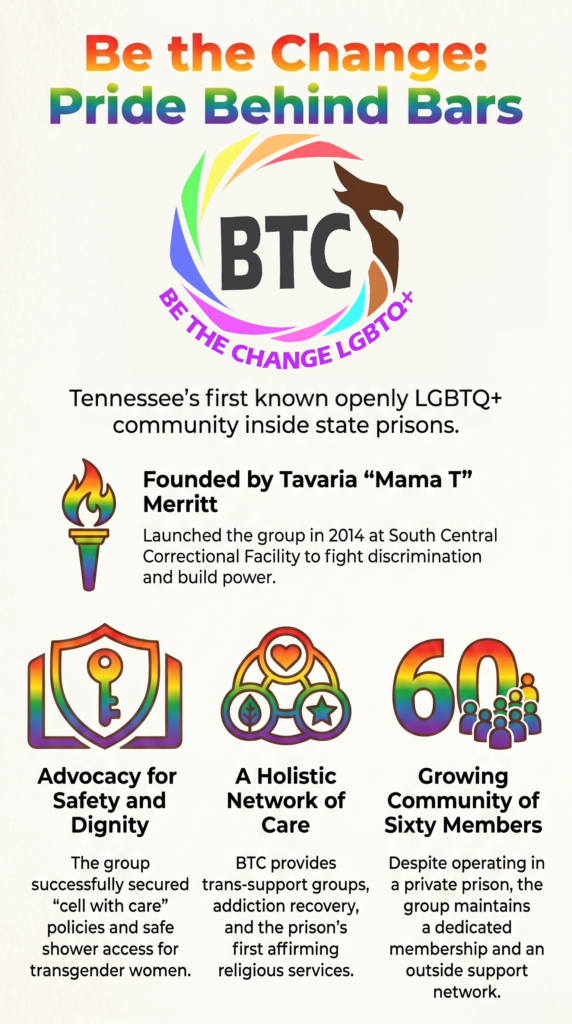
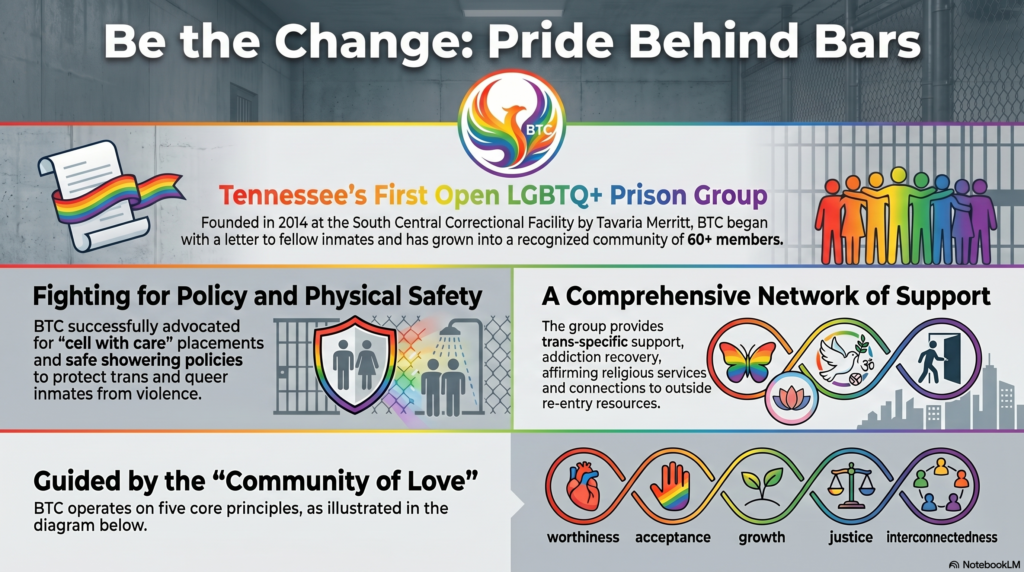
Be the Change is the first openly LGBTQ+ community network within the Tennessee prison system. Founded in 2014 by Tavaria Merritt, the organization provides a vital support system for incarcerated queer and transgender individuals. It focuses on three core pillars: religious inclusion, addiction recovery, and safety advocacy.
The group successfully advocated for improved medical care and protective housing policies to reduce violence against vulnerable inmates. By fostering mutual aid and peer mentorship, the movement established a culture of dignity within correctional facilities. Its influence extends beyond prison walls through ongoing community partnerships and reentry support.
In 2014, inside the walls of South Central Correctional Facility in Clifton, Tennessee, something quietly revolutionary began. A small circle of incarcerated LGBTQ+ people gathered under the leadership of Tavaria Merritt, a transgender woman and pastor who refused to accept the violence, isolation, and erasure that queer and trans people routinely face behind bars.
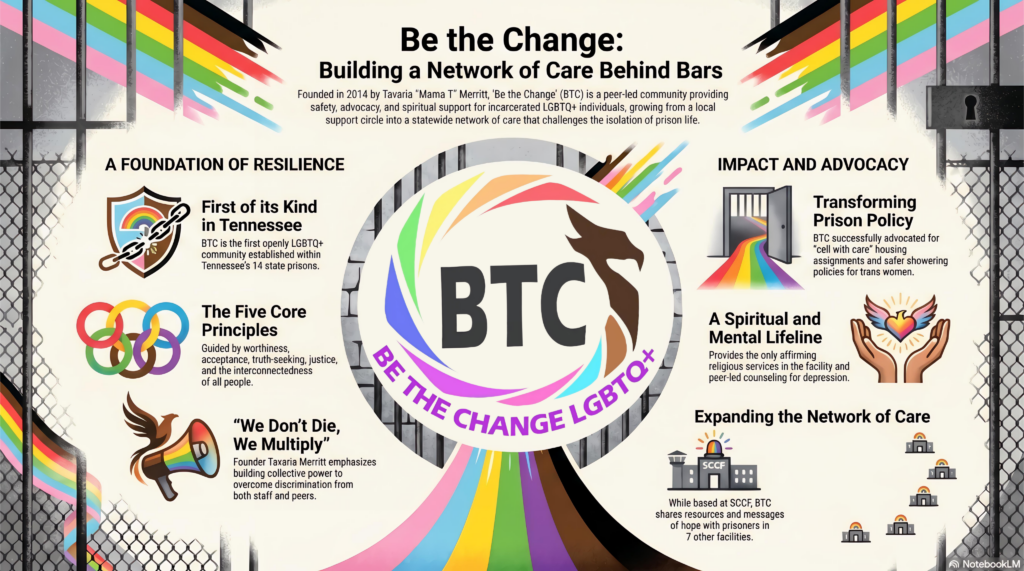
From that circle grew Be the Change (BTC) — the first openly LGBTQ+ community network within the Tennessee prison system, and one of the most significant grassroots movements for dignity and safety in the state’s correctional history.
A Community Born from Necessity
BTC emerged because LGBTQ+ people in prison often experience the harshest conditions: targeted violence, denial of medical care, exclusion from religious life, and barriers to addiction recovery programs.
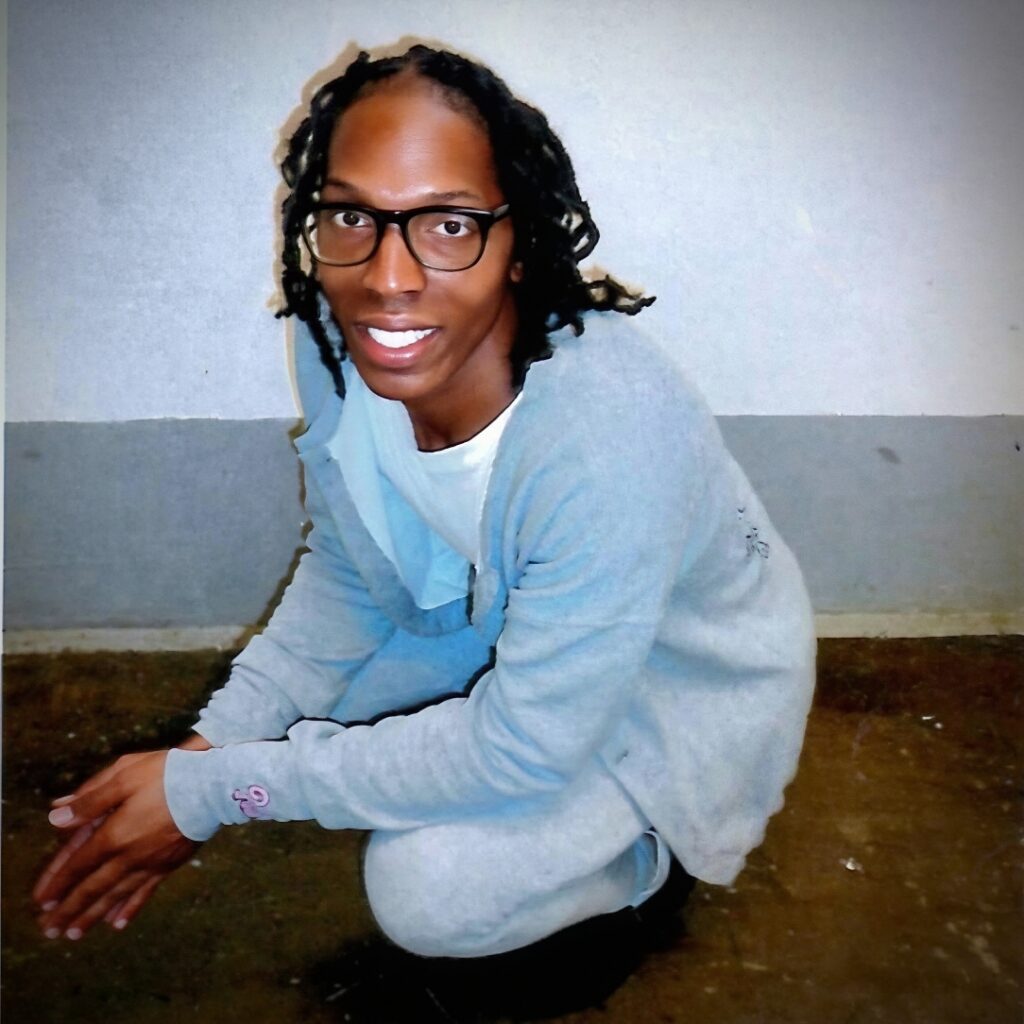
Under Merritt’s leadership, BTC became a lifeline. The group created a space where people could show up as their full selves — not as labels, not as stereotypes, but as human beings deserving of safety and belonging.
BTC’s mission grew around three pillars:
- Religious inclusion — ensuring LGBTQ+ people could participate fully in faith communities without discrimination.
- Addiction recovery — offering peer-led support for sobriety, trauma, and healing.
- Safety advocacy — challenging policies that left queer and trans inmates vulnerable to harm.
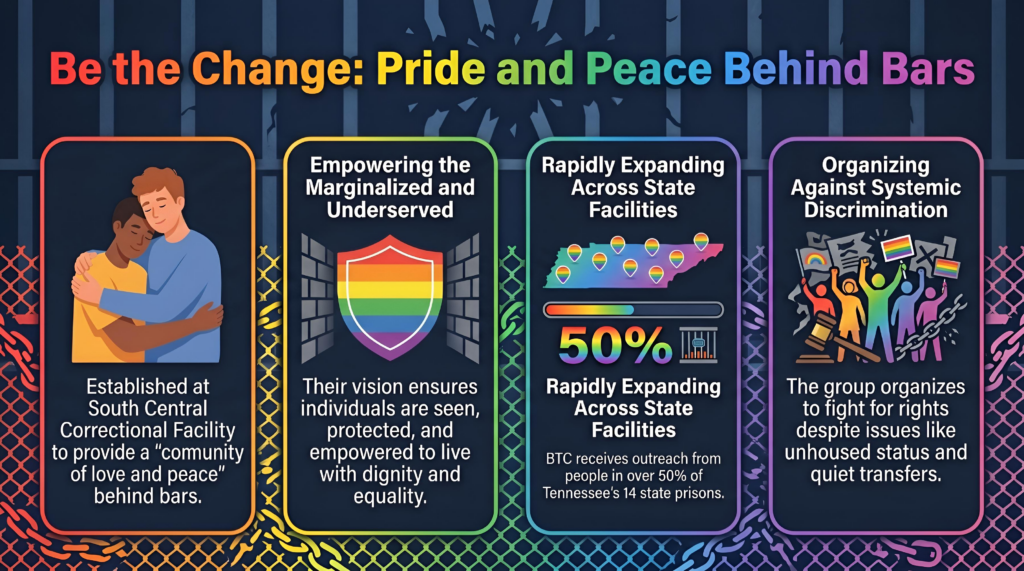
What began as mutual support soon evolved into organized activism.
Negotiating Safety in a System Built for Punishment
One of BTC’s most impactful achievements has been its work on protective housing policies.
Transgender inmates, in particular, are disproportionately targeted for violence. BTC members documented incidents, filed grievances, and pushed administrators to adopt safer placement practices. Their advocacy helped shift the conversation from “protective custody as isolation” to protective housing as dignity — a crucial distinction in a system where safety often comes at the cost of human contact.
BTC also fought for access to appropriate medical care for transgender people, including hormone therapy and mental‑health support. These efforts didn’t just change individual lives; they set precedents that affected facility wide policy.
Faith, Recovery, and Radical Inclusion
As a pastor, Tavaria Merritt understood that spiritual life is often the only refuge available to incarcerated people. BTC created inclusive worship spaces where LGBTQ+ individuals could pray, sing, and study scripture without fear of ridicule or exclusion.
This spiritual foundation strengthened BTC’s recovery work. Members supported each other through addiction, trauma, and the emotional toll of incarceration. Their approach blended peer mentorship with a deep commitment to accountability — a model that many outside organizations still struggle to replicate.
A Culture of Mutual Aid That Reaches Beyond the Prison Walls
BTC’s influence didn’t stop at the gates of South Central. Over time, its members built relationships with outside advocates, faith leaders, and LGBTQ+ organizations.
Former members carried BTC’s values into reentry programs, community centers, and churches. Some became mentors. Others became activists. All became proof that transformation is possible even in the most restrictive environments.
BTC’s legacy is not just the policies it changed — it’s the culture it created:
• Mutual aid instead of competition
• Dignity instead of dehumanization
• Visibility instead of silence
Why BTC’s Story Matters Today
At a time when LGBTQ+ rights are under renewed attack across the country — especially in the South — BTC stands as a reminder that resistance doesn’t always look like marches or headlines. Sometimes it looks like a small group of people in a prison dayroom, choosing to care for one another when the system refuses to.
BTC shows that:
- Queer and trans people have always organized for their own survival.
- Change can start anywhere — even in a place designed to break people down.
- Community is a form of power.
About Michael Eric Williams

Michael Eric Williams is a LGBTQ+ advocate and public policy communicator based in Nashville, Tennessee. He brings both empathy and strategic insight to his work. Michael’s writing often explores trauma-informed care, institutional reform, and the lived realities of LGBTQ+ communities in prison, blending meticulous documentation with personal storytelling. Michael believes in the power of truth, resilience, and public education to create change. In his personal life, Michael finds joy in spending time with his husband Todd and their 16 year old chihuahua, Ms. Alice.